



Dataflow and the Output node
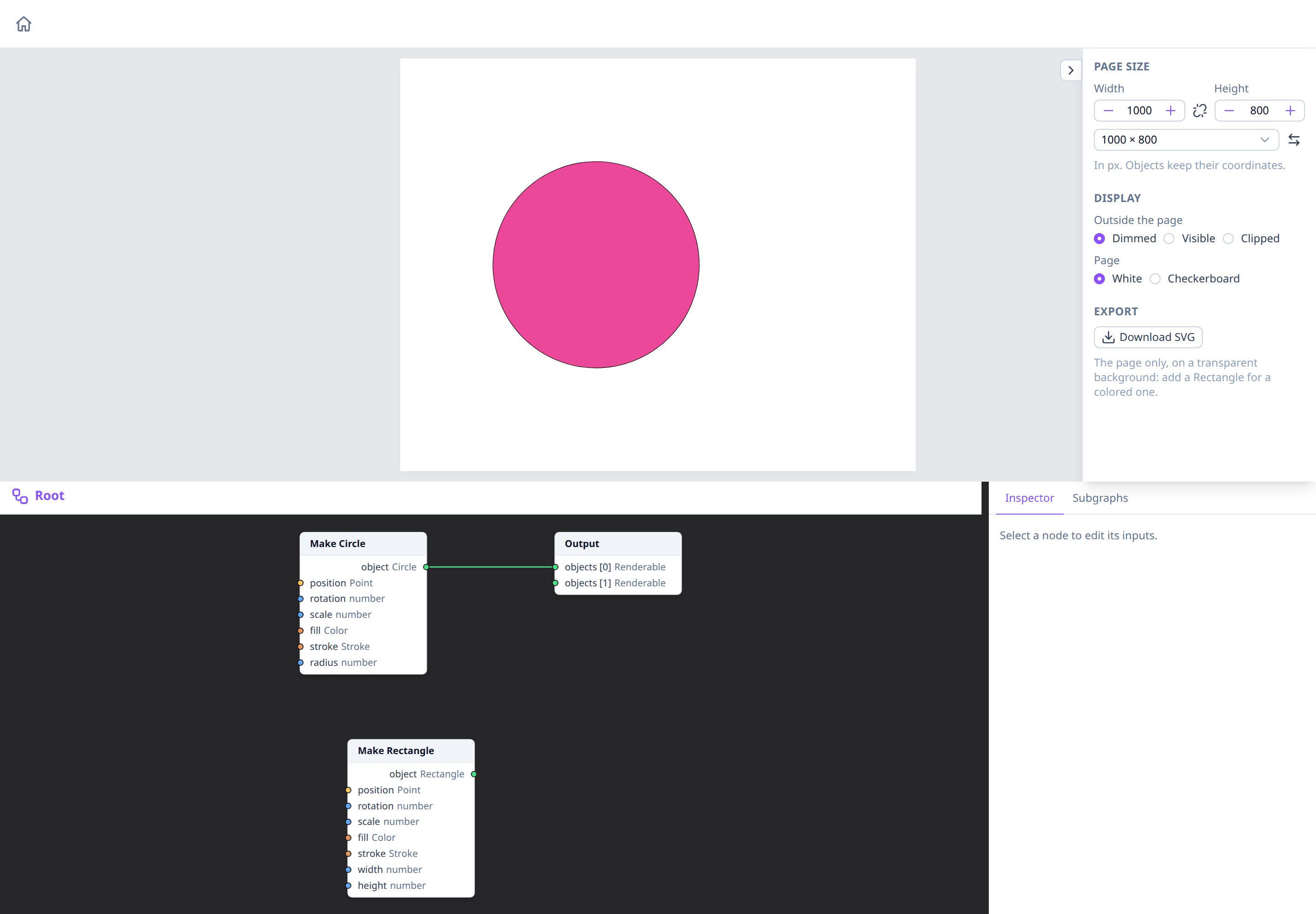
A graph describes a drawing as dataflow: values flow along wires, from the nodes that compute them to the nodes that use them. There are no steps to run in order. What matters is what is connected to what.
Nodes are pure
A node computes its outputs from its inputs and nothing else: given the same inputs, it always gives the same outputs, and it never changes anything outside itself. Even the random nodes follow this rule; see Determinism and random.
Nodes never change the values they receive either. Make, Set and the transform nodes give new objects: the object that came in is unchanged, so other nodes can use it too.
Evaluation starts from the Output
The drawing is whatever reaches the Output node. To draw it, the Playground asks the Output for its inputs, which asks the nodes connected to them for theirs, and so on back along the wires.
So only nodes that lead to the Output, directly or through other nodes, are evaluated:
- a node that isn't connected to the Output doesn't affect the drawing;
- it isn't checked either, so it shows no error even if its inputs are wrong;
- the position of nodes in the editor doesn't matter, only the wires.
Only what changed is computed again
Each node's result is kept until something it depends on changes. Editing a value re-evaluates that node and the nodes after it, not the whole graph, and the preview redraws once.
No loops
A wire can't lead back into the node it comes from, directly or through other nodes: the graph would never finish evaluating. Such a connection is refused, with a message.
Repeating something is done with nodes instead: Range and Map (for each element), or Repeat (until a condition). These need a function; see Subgraphs and functions.
Inputs that are only evaluated when needed
Some inputs are lazy: the node only asks for them when it needs them.
And stops at the first false and Or at the first true, so the
remaining inputs aren't evaluated at all, and can't fail.
Switch evaluates only the branch its condition
picks: "if … then … else" in a graph.
One Output, many objects
Every graph has exactly one Output node. Its objects input takes any
number of wires: unrelated objects are simply separate branches into it,
and the order of its slots is the drawing order, later ones on top.
To move, turn or scale several objects together, combine them with a Group node first.